
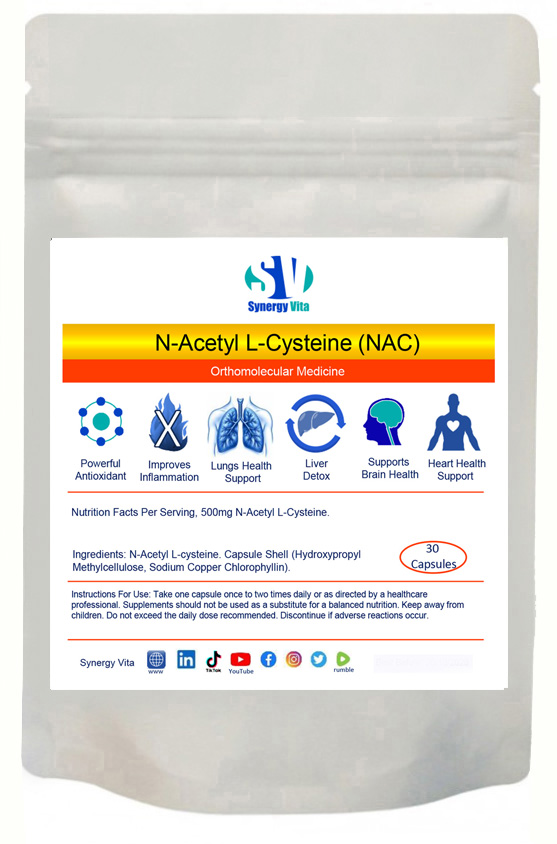
Nutrition Facts Per Serving: 500mg N-Acetyl L-Cysteine (NAC).
Ingredients: N-Acetyl L-cysteine. Capsule Shell (Hydroxypropyl Methylcellulose, Sodium Copper Chlorophyllin).
Instructions For Use: Take one capsule once to two times daily.
Benefits
- Glutathione support
- Antioxidant protection
- Anti-inflammatory activity
- Liver protection
- Respiratory support
- Neuroprotection
- Metabolic and cardiovascular support
SYNERGY VITA – N-Acetyl L-Cysteine (NAC).
NAC – Advanced Glutathione & Antioxidant Support
Give your body’s natural cellular defence system the support it deserves.
The science behind one of the body’s most important antioxidants
Your body is constantly working to maintain balance at a cellular level. Every day, your cells carry out thousands of biochemical processes that generate energy, support metabolism and maintain normal physiological function. These processes also produce reactive molecules known as free radicals.
When the production of these molecules exceeds the body’s ability to manage them, oxidative stress can occur. This is an important area of scientific research because oxidative stress is associated with cellular damage, inflammation and numerous aspects of human health.
One of the body’s most important natural defences against oxidative stress is glutathione. Often described as the body’s master antioxidant, glutathione is a powerful naturally occurring molecule found throughout the body, with particularly important roles inside cells.
This is where NAC comes in.
What is NAC and why is it so important?
NAC (N-Acetylcysteine) is a modified form of the amino acid L-cysteine. It has attracted considerable scientific interest because it provides the body with cysteine, an essential building block required for the production of glutathione.
Glutathione is made from three amino acids: cysteine, glutamate and glycine. Of these, cysteine availability can be a limiting factor in glutathione production.
By supplying cysteine, NAC provides an important precursor that the body can use to manufacture this essential antioxidant.
This is what makes NAC particularly interesting. Rather than simply introducing another antioxidant into your system, it provides a building block that supports one of the body’s own antioxidant production pathways.
- Glutathione production and cellular antioxidant defence
The relationship between NAC and glutathione is arguably the most researched aspect of this ingredient.
Glutathione plays several essential roles in cellular biology. It helps neutralise reactive molecules, supports antioxidant enzymes and contributes to maintaining the balance between oxidised and reduced molecules within cells.
This balance, known as cellular redox homeostasis, is fundamental to normal cellular function.
Scientific research has demonstrated that NAC can increase intracellular cysteine availability and support glutathione synthesis. This is particularly relevant because glutathione is involved in protecting cellular components from oxidative damage.
For anyone interested in cellular health, antioxidant biology and the body’s natural defence mechanisms, this is one of the most compelling reasons to explore NAC.
- Antioxidant protection against oxidative stress
Oxidative stress is an important research topic in modern health science.
It occurs when reactive oxygen and nitrogen species exceed the capacity of the body’s antioxidant systems to regulate them. These reactive molecules can interact with cellular structures, including proteins, lipids and DNA.
The body has sophisticated antioxidant systems to maintain this balance, with glutathione playing a central role.
NAC has two relevant mechanisms of action. Firstly, its sulphur-containing structure allows it to interact directly with certain reactive molecules. Secondly, and arguably more importantly, it supports glutathione production by providing cysteine.
These mechanisms have made NAC a particularly interesting subject in research investigating antioxidant protection and cellular health.
- Research into healthy inflammatory responses
Inflammation is a natural biological process involved in the body’s response to injury, infection and other challenges.
However, inflammatory signalling is complex and involves numerous molecules and pathways.
Research has investigated NAC’s interaction with NF-κB, a transcription factor involved in regulating genes associated with inflammatory responses.
Experimental studies have shown that NAC can influence NF-κB signalling and the production of inflammatory mediators, including TNF-alpha, IL-6 and IL-1 beta.
These findings help explain why NAC has attracted interest in research exploring the relationship between oxidative stress and inflammation.
- Liver health and glutathione
The liver is one of the body’s most metabolically active organs. It plays a central role in processing nutrients, metabolising substances and maintaining normal metabolic function.
Glutathione is particularly abundant in liver tissue, where it participates in important antioxidant and detoxification processes.
One of the most established medical applications of NAC is its use in treating paracetamol overdose. In this setting, NAC helps restore glutathione availability and protects against potentially severe liver injury.
This is an important demonstration of the biological significance of the NAC-glutathione relationship.
NAC’s use in treating paracetamol overdose demonstrates how important glutathione is for protecting the liver. By helping restore glutathione levels, NAC plays a vital role in protecting liver cells from damage.
- Respiratory health and mucus clearance
NAC has another fascinating property: its mucolytic activity.
Mucus contains proteins linked together by chemical bonds that contribute to its thickness and consistency. NAC can interact with these disulphide bonds, changing the structure of mucus and reducing its viscosity.
This makes it easier to understand why NAC has been used medically as a mucolytic agent to help loosen thick mucus in certain respiratory conditions.
Clinical studies have shown that NAC can help support respiratory health in people with chronic obstructive pulmonary disease (COPD), particularly by helping break down thick mucus, making it easier to clear from the airways. Research has also explored its potential to reduce the frequency of respiratory flare-ups.
- Neuroprotection
NAC has attracted growing scientific interest for its potential role in supporting brain health and protecting nerve cells against oxidative stress. By helping replenish glutathione levels in the brain, NAC may support the body’s natural defences against cellular damage. Research has also explored its potential to regulate neuroinflammation and support healthy brain function.
- Metabolic and cardiovascular support
NAC’s antioxidant properties have made it an interesting subject in research into metabolic and cardiovascular health. Studies have investigated its potential to support insulin sensitivity, healthy blood sugar regulation and the body’s ability to manage oxidative stress. Research has also explored its role in supporting blood vessel function and cardiovascular health, particularly through its effects on oxidative stress and nitric oxide availability.
Why choose NAC?
NAC is much more than an ingredient with antioxidant potential. Its scientific appeal lies in its relationship with one of the body’s most important endogenous antioxidant systems.
By providing cysteine, NAC contributes to the biochemical pathway involved in glutathione production. This makes it an interesting ingredient for people who value nutritional science, cellular biology and research-led supplementation.
If you’re looking to make informed choices about your nutritional routine, NAC is an ingredient with a particularly fascinating scientific background.
Choose NAC. Choose science-led nutritional support.
References (APA Style)
Aldini, G., Altomare, A., Baron, G., Vistoli, G., Carini, M., Borsani, L., & Sergio, F. (2018). N-Acetylcysteine as an antioxidant and disulphide breaking agent: The reasons why. Free Radical Research, 52(7), 751–762.
Rushworth, G. F., & Megson, I. L. (2014). Existing and potential therapeutic uses for N-acetylcysteine: The need for conversion to intracellular glutathione for antioxidant benefits. Pharmacology & Therapeutics, 141(2), 150–159.
Tenório, M. C. dos S., Graciliano, N. G., Moura, F. A., de Oliveira, A. C. M., & Goulart, M. O. F. (2021). N-Acetylcysteine (NAC): Impacts on human health. Antioxidants, 10(6), 967.

Reviews
There are no reviews yet.