
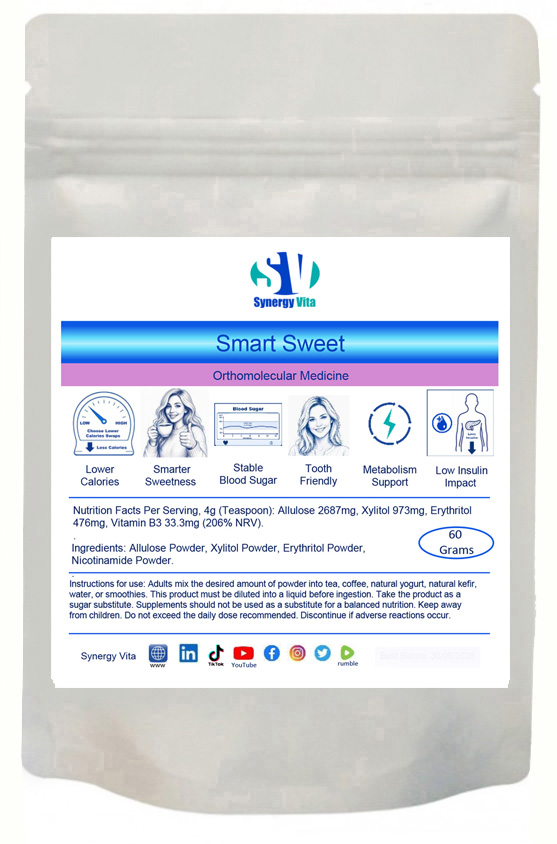
Benefits of Smart Sweet Sugar Substitute
Lower calories
Smarter sweetness
Stable blood glucose
Tooth friendly
Metabolism support
Low insulin impact
ATP production
Enhanced cognitive performance
Reduced obesity risk
Cellular metabolism support
Reduced risk of type 2 diabetes
Improved mitochondrial function
SYNERGY VITA – SMART SWEET
The Smarter Way to Sweeten
The Sweetness You Love. The Sugar You Don’t Need.
Table sugar (sucrose) consumption has become one of the greatest nutritional challenges facing modern society. Added sugars are consumed in unprecedented amounts, largely through processed foods and sugar-sweetened beverages, contributing to rising rates of obesity, insulin resistance, type 2 diabetes, cardiovascular disease, fatty liver disease and tooth decay. The scientific evidence is clear: reducing added sugar intake is one of the most effective steps individuals can take to improve long-term health.
Synergy Vita Smart Sweet was developed to help make that change easier. Rather than relying on a single sweetener, Smart Sweet combines different sweeteners (found naturally in very small amounts in some fruits), creating a balanced blend that closely mimics the taste, texture and functionality of sugar while avoiding many of its metabolic disadvantages.
Unlike sucrose, Smart Sweet contains no sucrose, no fructose, and delivers substantially fewer calories. It produces minimal effects on blood glucose and insulin, making it a practical alternative for people seeking to reduce their sugar intake or better manage their overall metabolic health. Because the ingredients are not readily fermented by oral bacteria, Smart Sweet is also far kinder to teeth than ordinary sugar, with xylitol providing additional evidence-based dental benefits.
But Smart Sweet goes one step further. Every serving also provides vitamin B3 (nicotinamide), an essential nutrient that serves as the precursor to NAD⁺, one of the body’s most important coenzymes. NAD⁺ is required for hundreds of biochemical reactions involved in energy production, cellular metabolism, DNA repair and normal cellular function. As NAD⁺ levels naturally decline with age, maintaining an adequate intake of vitamin B3 is essential for supporting healthy metabolism and cellular wellbeing. While research into NAD⁺ and healthy ageing continues to evolve, the established role of vitamin B3 in maintaining normal metabolic function and cellular health is well supported by decades of scientific research.
Smart Sweet is not a medicine, nor is it a licence to consume more sweet foods. Instead, it is a practical, science-based replacement for sucrose that enables you to enjoy sweetness while dramatically reducing your exposure to refined sugar. Every spoonful you replace is one less source of empty calories, glucose spikes and fructose burden. Over weeks, months and years, these small daily choices can add up to meaningful improvements in dietary quality and long-term health.
The future of sweetness is not more sugar, it is smarter options. Choosing Smart Sweet means choosing a sweetener designed for the way we understand nutrition today: one that respects both your taste buds and your metabolism. If we are serious about reversing the global burden of sugar-related disease, replacing sucrose with healthier alternatives is one of the simplest and most powerful changes we can make. Smart Sweet makes that healthier choice easy, without asking you to give up the sweetness you enjoy.
References
American Diabetes Association Professional Practice Committee. (2024). Standards of care in diabetes—2024. Diabetes Care, 47(Supplement 1), S1–S321.
Borges, S. S., Oliveira, M. C., & da Silva, A. C. (2022). Effects of allulose consumption on metabolic parameters: A systematic review and meta-analysis. Nutrients, 14(19), 3984.
Bray, G. A., & Popkin, B. M. (2014). Dietary sugar and body weight: Have we reached a crisis in the epidemic of obesity and diabetes? Health Affairs, 33(4), 605–609.
Cohen, L., & LeRoith, D. (2012). Obesity, type 2 diabetes, and cancer: The insulin and insulin-like growth factor connection. Endocrine-Related Cancer, 19(5), F27–F45.
Cummings, J. H., & Stephen, A. M. (2007). Carbohydrate terminology and classification. European Journal of Clinical Nutrition, 61(Suppl 1), S5–S18.
European Food Safety Authority. (2010). Scientific opinion on the substantiation of health claims related to xylitol and reduction of post-prandial blood glucose responses and maintenance of tooth mineralisation. EFSA Journal, 8(10), 1757.
European Food Safety Authority. (2015). Scientific opinion on the re-evaluation of erythritol (E 968) as a food additive. EFSA Journal, 13(3), 4037.
European Food Safety Authority Panel on Nutrition, Novel Foods and Food Allergens. (2023). Scientific opinion on the safety of the proposed extension of use of D-allulose as a novel food. EFSA Journal, 21(6), e08022.
Fattore, E., & Massa, E. (2017). Dietary sugars and health: The evidence for action. Nutrition Research Reviews, 30(1), 1–15.
Foster-Powell, K., Holt, S. H. A., & Brand-Miller, J. C. (2002). International table of glycemic index and glycemic load values: 2002. The American Journal of Clinical Nutrition, 76(1), 5–56.
Goran, M. I., Ulijaszek, S. J., & Ventura, E. E. (2013). High fructose corn syrup and diabetes prevalence: A global perspective. Global Public Health, 8(1), 55–68.
Institute of Medicine. (2005). Dietary reference intakes for energy, carbohydrate, fiber, fat, fatty acids, cholesterol, protein, and amino acids. National Academies Press.
Johnson, R. K., Appel, L. J., Brands, M., Howard, B. V., Lefevre, M., Lustig, R. H., Sacks, F., Steffen, L. M., & Wylie-Rosett, J. (2009). Dietary sugars intake and cardiovascular health: A scientific statement from the American Heart Association. Circulation, 120(11), 1011–1020.
Kahn, R., & Sievenpiper, J. L. (2014). Dietary sugar and body weight: Have we reached a crisis in the epidemic of obesity and diabetes? Commentary on dietary sugars. Diabetes Care, 37(4), 957–962.
Katsube, T., Yamada, Y., & Tsuruma, K. (2018). Effects of erythritol on postprandial glucose and insulin responses in humans. Journal of Nutritional Science and Vitaminology, 64(2), 83–88.
Kirkland, J. B. (2012). Niacin requirements for genomic stability. Mutation Research/Fundamental and Molecular Mechanisms of Mutagenesis, 733(1–2), 14–20.
Lustig, R. H. (2013). Fructose: Metabolic, hedonic, and societal parallels with ethanol. Journal of the American Dietetic Association, 113(5), 716–725.
Maki, K. C., Curry, L. L., Reeves, M. S., Toth, P. D., McKenney, J. M., Carson, M. L., & Dicklin, M. R. (2008). Chronic consumption of xylitol sweetened foods appears to reduce dental caries incidence. Clinical, Cosmetic and Investigational Dentistry, 1, 1–10.
Malik, V. S., Popkin, B. M., Bray, G. A., Després, J. P., & Hu, F. B. (2010). Sugar-sweetened beverages and risk of metabolic syndrome and type 2 diabetes: A meta-analysis. Diabetes Care, 33(11), 2477–2483.
Malik, V. S., Li, Y., Pan, A., De Koning, L., Schernhammer, E., Willett, W. C., & Hu, F. B. (2019). Long-term consumption of sugar-sweetened and artificially sweetened beverages and risk of mortality in US adults. Circulation, 139(18), 2113–2125.
Mooradian, A. D., Smith, M., & Tokuda, M. (2017). The role of artificial and natural sweeteners in reducing the consumption of table sugar: A narrative review. Clinical Nutrition ESPEN, 18, 1–8.
Rippe, J. M., & Angelopoulos, T. J. (2016). Relationship between added sugars consumption and chronic disease risk factors: Current understanding. Nutrients, 8(11), 697.
Schiavon, C. A., Bordin, S., & Carpinelli, A. R. (2021). Allulose: A promising low-calorie sugar substitute. Nutrients, 13(10), 3442. https://doi.org/10.3390/nu13103442
Suez, J., Korem, T., Zeevi, D., Zilberman-Schapira, G., Thaiss, C. A., Maza, O., Israeli, D., Zmora, N., Gilad, S., Weinberger, A., et al. (2014). Artificial sweeteners induce glucose intolerance by altering the gut microbiota. Nature, 514, 181–186.
Tappy, L. (2018). Fructose-containing caloric sweeteners as a cause of obesity and metabolic disorders. Journal of Experimental Biology, 221(Suppl 1), jeb164202.
Verdin, E. (2015). NAD⁺ in aging, metabolism, and neurodegeneration. Science, 350(6265), 1208–1213.
World Health Organization. (2015). Guideline: Sugars intake for adults and children. World Health Organization.
Yoshino, J., Baur, J. A., & Imai, S. I. (2018). NAD⁺ intermediates: The biology and therapeutic potential of NMN and NR. Cell Metabolism, 27(3), 513–528.
Reviews
There are no reviews yet.